Cannot get to a studio? Compare practising alone, live online classes, one-to-one sessions and a teacher at your home, and how to choose.
Not everyone can get to a studio at a fixed time twice a week.
You might work shifts, live on the other side of the valley, have small children, be travelling, or simply find that the classes you want are scheduled when you cannot attend. None of that means yoga is closed to you.
There are four practical alternatives to a group studio class: practising alone at home, joining a live online class, booking a one-to-one session, or having a teacher come to your space. They suit different people and different problems, and they are easy to confuse.
This guide explains what each one is actually like, and how to choose.
Practising alone at home
Practising by yourself is the cheapest and most flexible option, and for some people it works beautifully.
It also has real limitations that are worth naming.
Nobody can see what you are doing. A misaligned habit can quietly build over months. Motivation is harder without a fixed time and other people. And when something hurts, there is nobody to ask.
That does not mean it is a bad idea. It means it works best as a supplement to occasional guided practice rather than as a complete replacement, particularly in your first year.
If you practise alone, a few things help:
- A fixed time beats a fixed length. Ten minutes daily at the same hour builds more than an occasional ambitious hour.
- Keep the mat visible. Practice that requires unpacking equipment happens less often.
- Work within a familiar range. Alone is not the time to attempt something you have only seen in a photograph.
- Stop if something is sharp. Discomfort and pain are different, and without a teacher you are the only one who can make that call.
Live online classes
A live online class is a real class with a real teacher, happening at a scheduled time, with you joining by video from wherever you are.
This is quite different from following a recorded video. The teacher can see you, correct you, offer alternatives, and answer a question in the moment. You are practising with other people rather than watching someone practise.
It suits you if you are outside Kathmandu, in a different country or time zone, travelling, unable to commit to travel time, or simply more comfortable practising in your own space at first.
What you need is unremarkable: enough floor space to lie down and extend your arms, a device you can prop up where the teacher can see you, and a reasonably stable connection. A mat helps but a carpet or folded blanket will do to begin with.
What it does not give you is hands-on adjustment, and the teacher's view of you is limited by the camera. Tell them about injuries and concerns at the start, because they cannot notice as much as they would in the room.
Yogmandu runs live online classes from NPR 500 per class, with packages for regular students. Because they are live rather than recorded, time zones are worth checking when you book.
One-to-one private sessions
A private session is the whole class, built around you.
This is the right choice more often than people assume. It suits you if you are recovering from injury, managing a health condition, nervous about group settings, working towards something specific, have an unusual schedule, or have tried group classes and found the pace wrong in either direction.
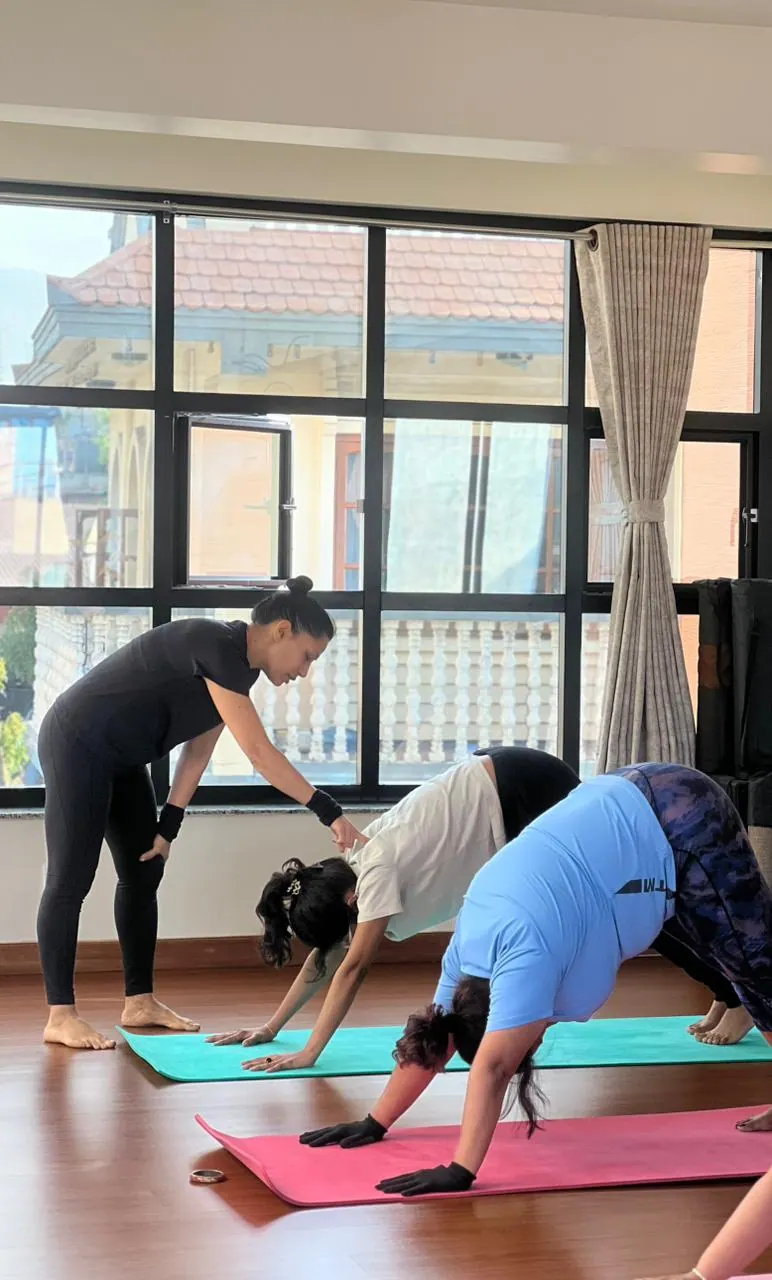
It is also the fastest way to fix a technique problem. A teacher watching one person for an hour sees things that are invisible in a room of fifteen.
Private sessions at Yogmandu run by appointment, at the studio or your own location. If you have a medical condition, a recent injury or persistent pain, this is usually a better starting point than a group class — and for ongoing pain, yoga therapy takes that further with a properly therapeutic approach.
The trade-off is cost per session, and the absence of a group. Some people find practising with others motivating in a way that one-to-one is not.
A teacher at your home
The fourth option is in-person but at your place rather than the studio.
Yoga at home means a teacher travels to you, in and around Kathmandu, by appointment. You get everything a private studio session offers, without the travel, in a space you are already comfortable in.
It suits new parents, people with mobility difficulties, households where several family members want to practise together, and anyone for whom getting across Kathmandu at a fixed hour is the actual obstacle.
Practical points worth knowing: you need a clear floor area roughly two metres by one metre per person, somewhere reasonably quiet, and it is worth agreeing in advance whether mats are provided or expected.
Which should you choose?
A rough guide rather than a rule.
- Distance or a different time zone — live online classes.
- A fixed schedule you cannot meet — private sessions by appointment.
- Injury, pain or a health condition — private sessions, or yoga therapy.
- Travelling across the city — a teacher at your home.
- Cost — practising alone, with occasional guided sessions to check your technique.
- Self-consciousness in groups — online or one-to-one to begin with.
Most people end up combining two. A common and sensible pattern is occasional guided sessions to correct what you are doing, with regular short practice alone between them.
Learning to teach, remotely
If your interest goes beyond personal practice, teacher training also has a remote route.
Yogmandu's online 200-hour teacher training delivers the same Yoga Alliance RYT 200 curriculum as the in-person programmes, for people who cannot travel to Kathmandu for a month. If you are weighing that against coming in person, our guide to RYT 200, 300 and 500 explains how the credentials fit together.
Be realistic about what remote study asks of you. It requires more self-discipline than an immersive residential month, where the environment does much of the work for you.
What none of these formats change
Whichever you choose, some things stay the same.
Tell your teacher about injuries, pregnancy, medical conditions and pain before you begin — this matters more online, not less, because they can see less of you.
Rest when you need to. Work within your own range rather than someone else's. And if a movement produces sharp pain, numbness, tingling or dizziness, stop and get advice rather than practising through it.
If you are completely new to any of this, our guide to your first yoga class covers what to expect, what to wear and what nobody tells beginners.
How we approach this at Yogmandu
At Yogmandu we treat these as genuinely different formats rather than lesser versions of a studio class. An online class is planned for what a teacher can see through a camera. A home session is planned around a living room rather than a studio floor. A private session is planned around one person's history and goals.
We would rather steer you to the format that fits than sell you the one that is most convenient to schedule. If you are managing an injury, we will suggest one-to-one over a group class. If cost is the constraint, we will say so and point you at a drop-in instead.
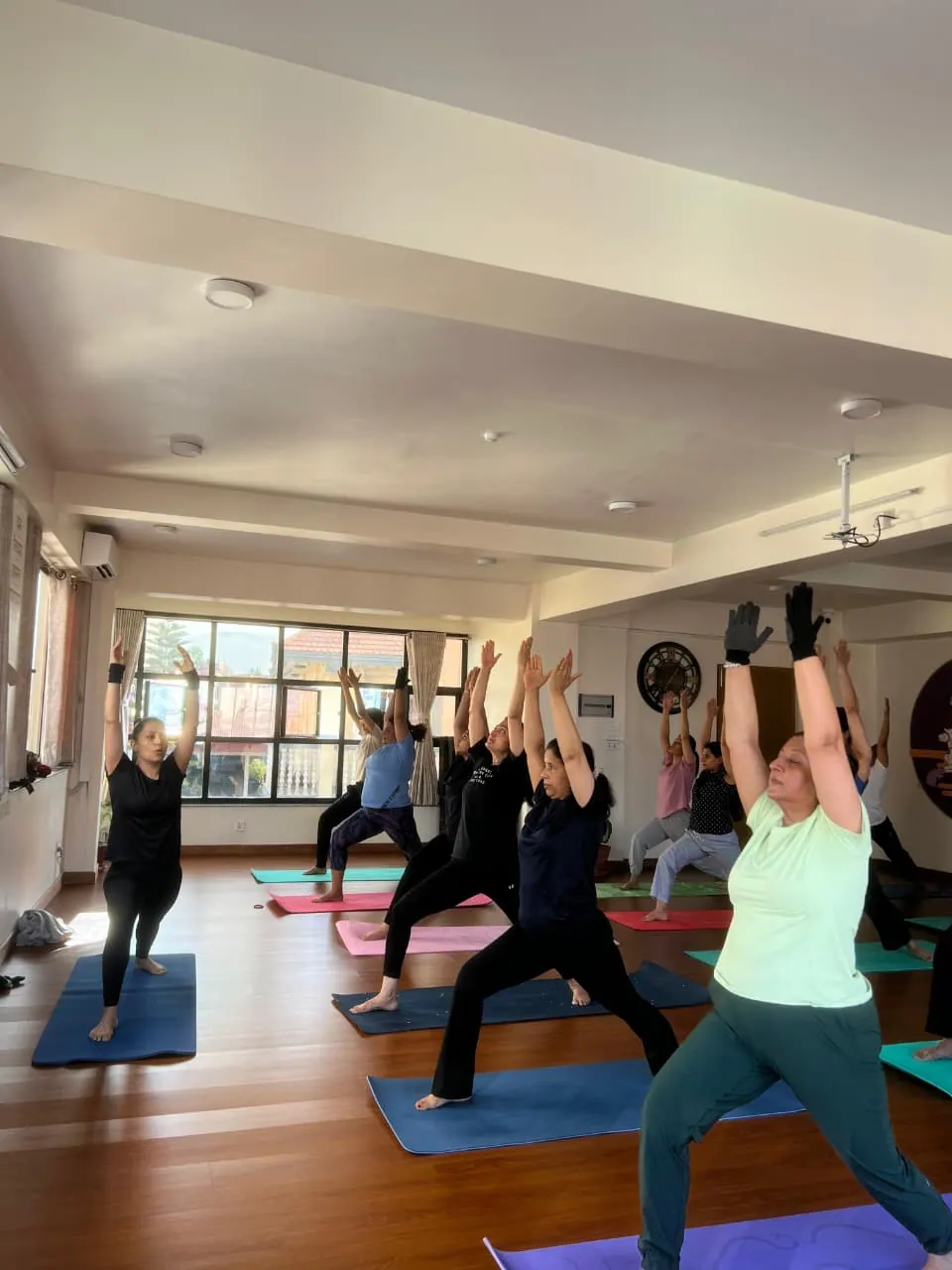
Yogmandu is a yoga school in Mid-Baneshwor, Kathmandu, founded in 2018. Alongside these formats we run regular studio classes if your circumstances change and getting to us becomes easier.
Frequently asked questions
### Is an online class as good as being in the room?
For many purposes it is close, but it is not identical. You lose hands-on adjustment and the teacher's view is limited by your camera. You gain access, flexibility and the ability to practise from anywhere.
### How much space do I need at home?
Enough to lie flat and extend your arms without hitting furniture — roughly two metres by one metre. You do not need a dedicated room.
### Do I need a proper yoga mat to start?
It helps, particularly on a hard floor, but a carpet, rug or folded blanket is enough for your first few sessions. Do not let equipment delay you.
### Can a beginner start with private or online sessions?
Yes, and for some people it is easier than walking into a group class. Say clearly that you are a beginner when you book so the session is pitched appropriately.
### Can several people share one home session?
Usually yes, provided there is floor space for everyone. Mention how many people and their experience levels when arranging it, since a mixed-ability household needs a different plan from one person practising alone.