How to Choose a Yoga Teacher Training in Nepal
What to check in any yoga school in Nepal, how residential, non-residential and online 200-hour training compare, and eight questions to ask before you pay a deposit.
Search for "yoga teacher training in Nepal" and you will find dozens of schools, most of them promising the same things: Yoga Alliance certification, Himalayan views, small groups, authentic tradition. The websites look alike. The prices do not.
Choosing well matters. A 200-hour training is four weeks of your life, a significant sum of money, and the foundation of everything you will teach afterwards. This guide sets out what to check in any school, how the three training formats differ, and the questions worth asking before you pay a deposit. It applies whether you train with us or somewhere else.
Start with what you want from the training
Before comparing schools, be honest about why you are going.
- To teach professionally. You need solid teaching methodology, plenty of supervised practice teaching, and a certificate that lets you register with Yoga Alliance.
- To deepen your own practice. Many trainees never plan to teach. You may care more about philosophy, pranayama and meditation, and about the teacher's depth, than about the teaching practicum.
- To experience Nepal. If the trip matters as much as the course, think about location, season and free time, and whether you want to add travel or a trek afterwards.
Most people are a mix of all three. Knowing which comes first makes every other decision easier.
Seven things to check in any yoga school
### 1. Yoga Alliance registration you can verify
"Yoga Alliance certified" is the phrase every school uses. What it should mean is that the school is a Registered Yoga School (RYS) and its 200-hour programme meets Yoga Alliance's standards, so graduates can register as RYT 200 teachers.
Do not take the logo on trust. Search for the school by name in the Yoga Alliance directory on the Yoga Alliance website. Check that the registration is current and that it covers the programme you are booking. Our article on RYT 200, 300 and 500 explains what each level means.
### 2. Who actually teaches
Find the name of the lead trainer and look them up. How long have they been teaching? What is their own training and lineage? Will they teach most of the course, or appear on the first and last day?
Ask who teaches anatomy and philosophy. These are the subjects where a weak school shows most clearly, because a strong asana teacher is not automatically qualified in either.
### 3. Group size
Small groups mean more correction, more teaching practice and more time with the lead trainer. A cohort of 30 or 40 is a lecture. A cohort of 10 to 15 is a training.
Ask for the maximum number of students, not the typical one. At Yogmandu each 200-hour cohort is limited to 12.
### 4. The daily schedule
A real 200-hour course is demanding. Expect early mornings, long days and evening study. Ask for a sample daily timetable and check that it adds up to the hours promised: asana, pranayama, meditation, anatomy, philosophy, teaching methodology and practice teaching.
Be wary of a schedule with large blocks of unexplained free time, or a course that claims 200 hours in far fewer than three weeks.
### 5. How much you will actually teach
Practice teaching is what turns students into teachers. Ask how many times you will lead a class during the course, how big the group is, and how you receive feedback. If the answer is vague, assume it is not much.
### 6. The full cost, not just the fee
Compare like with like. Some prices include accommodation and all meals; some include nothing but tuition. Add up:
- Tuition, and what it covers: manual, materials, certificate.
- Accommodation and meals, if not included.
- Flights and travel insurance.
- Your Nepal visa. Most nationalities can get a tourist visa on arrival; check current fees with Nepal's Department of Immigration before you travel.
- Local transport, laundry and any excursions.
### 7. Deposit and cancellation terms
Read these before paying. How much is the deposit, is it refundable, and can it be transferred to a later cohort? What happens if the school cancels, or if you fall ill? Good schools publish this clearly.
Residential, non-residential or online?
Most schools in Nepal now offer more than one format. At Yogmandu all three lead to the same Yoga Alliance RYT 200 eligible certificate and follow the same curriculum. Only the setting and inclusions differ.

### Residential (full board)
You live, eat and train in one place for the whole course. At Yogmandu the residential programme is USD 1,400 and includes 25 nights of shared accommodation, three organic vegetarian meals a day, herbal teas, a shatkarma kit, two Ayurvedic massages and your training manual.
Best for: first-time visitors to Nepal, anyone who wants full immersion, and people who would rather not spend energy finding food and housing in a new city.
The trade-off: less privacy and independence. You share a room and follow the group's rhythm from morning to night. See the residential training.
### Non-residential (commuter)
You attend the same 28-day course but arrange your own accommodation and come to the studio each day. At Yogmandu this is USD 600 for tuition only.
Best for: people who live in Kathmandu, travellers who want their own space or are travelling with a partner, and anyone with specific dietary needs who prefers to cook.
The trade-off: you lose some of the community that forms when a group lives together, and you must budget for housing and food. Guesthouses and apartments near Mid-Baneshwor are plentiful, and we are happy to suggest some. See the non-residential training.
### Online (live)
You join the course live over Zoom, in real time, alongside the Kathmandu cohort. At Yogmandu it is USD 500, or NPR 40,000 for Nepali citizens.
Best for: people who cannot take four weeks away from work or family, or cannot travel right now.
The trade-off: no hands-on adjustment and no physical presence in a room with your teachers and classmates. You need a quiet space, a stable connection and real self-discipline. Make sure any online course you consider is taught live and includes supervised teaching practice, not just recorded videos. See the online training.
Questions to ask before you pay a deposit
Copy these into a message to any school you are considering:
1. Can you confirm your Yoga Alliance RYS registration and the name it is listed under? 2. Who is the lead trainer, and how many of the course hours will they teach? 3. What is the maximum group size for my intake? 4. Can I see a sample daily timetable? 5. How many times will I lead a class, and how is it assessed? 6. Exactly what does the fee include? 7. What are the deposit, refund and transfer terms? 8. Can I speak to a past graduate?
A good school answers all eight quickly and plainly. Hesitation over any of them tells you something.
When to go
Kathmandu can be a good place to train in any season, but each has trade-offs: clear skies in autumn and spring, a cool dry winter, and a green, wet, quieter monsoon. Our guide to the best time for yoga training in Kathmandu goes through the year month by month. If you are travelling from abroad for the first time, also read traveling to Nepal for yoga teacher training.
How Yogmandu answers these questions
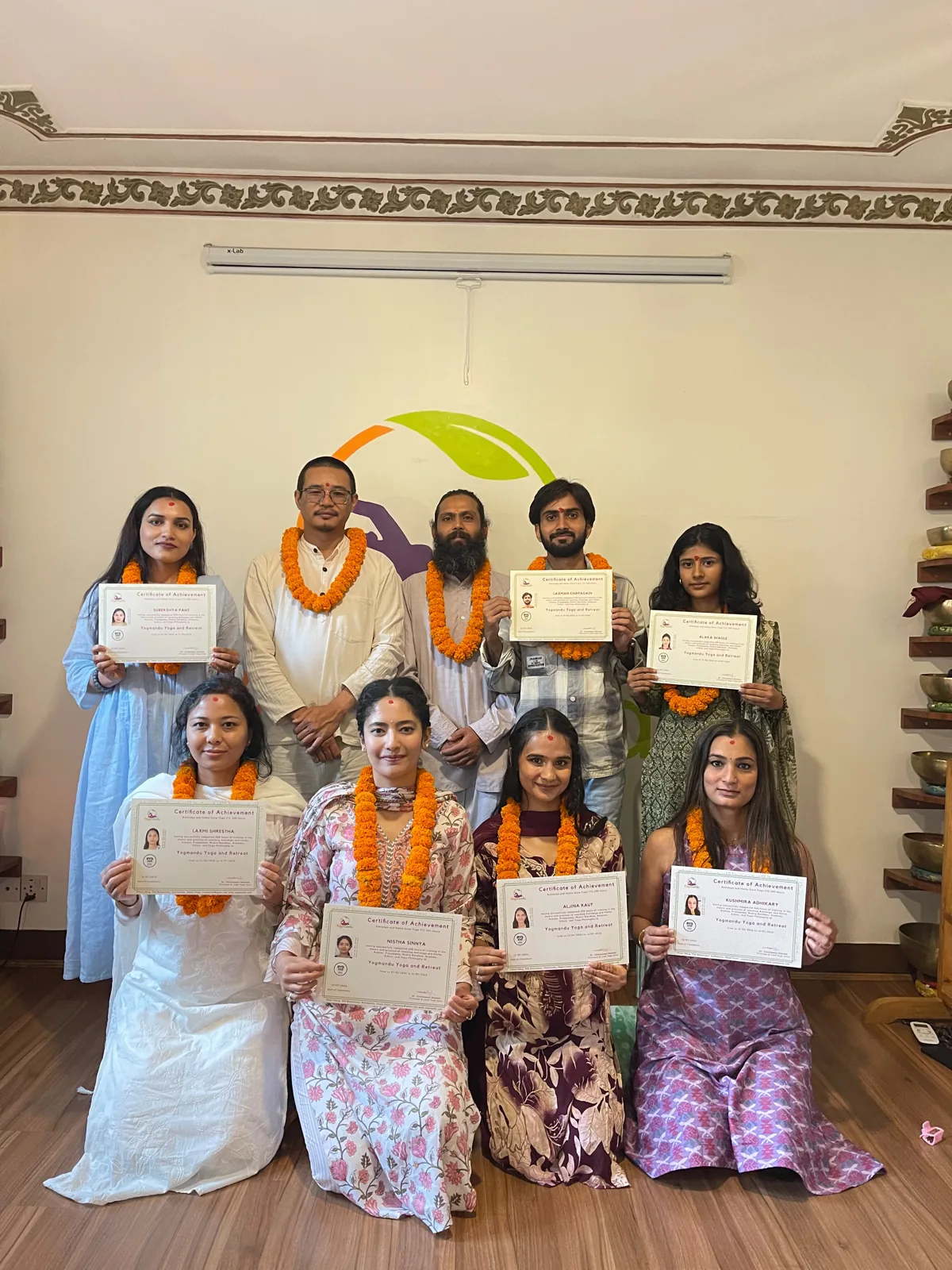
We have run teacher training in Kathmandu since 2018 as a Yoga Alliance Registered Yoga School. The programme is led by Dr. Chintamani Gautam (PhD in Yogic Science, E-RYT 500) with our senior faculty. Each cohort is capped at 12 students, a new 200-hour cohort starts every month, and a USD 200 deposit secures your place.
You can compare everything on our teacher training page, choose your intake month, or message us on WhatsApp at +977-9810263277 with any of the questions above. We would rather you choose the right course than the fastest one to book.