
Retreat or Himalayan trek? An honest guide to what each involves, altitude safety, fitness, seasons and how to choose the right one.
There is a particular kind of tiredness that a weekend does not fix.
A retreat is not a holiday, and it is not a fitness camp. At its simplest it is a stretch of days where the ordinary demands are removed, the schedule is decided for you, and practice happens more than once a day. What changes is not usually the yoga. It is the absence of everything else.
Nepal is a good place to do that, for reasons that are partly practical and partly geographic. But there is a lot of romantic writing about Himalayan retreats and not much plain description of what they actually involve.
This is the plain version.
Retreat or trek — they are not the same thing
These get blurred together in marketing, and they ask quite different things of you.
A retreat is mostly stationary. You stay in one place, practise two or three times a day, eat simply, rest, and have long unstructured gaps. The physical demand is moderate. The difficulty, for most people, is the stillness rather than the effort.
A yoga trek combines walking on Himalayan trails with daily practice. You move between places, carrying at least a daypack, walking for several hours most days. Practice is usually shorter and more functional — opening hips and shoulders that have been under a rucksack, rather than long sessions.
If you want rest, take a retreat. If you want the mountains and are reasonably fit, take a trek. Choosing a trek because it sounds more impressive is how people end up exhausted and disappointed.
Yogmandu runs yoga trekking on Himalayan trails in small groups with daily practice, alongside a wider range of retreats.
What a retreat day usually looks like
Schedules vary, but the shape is consistent.
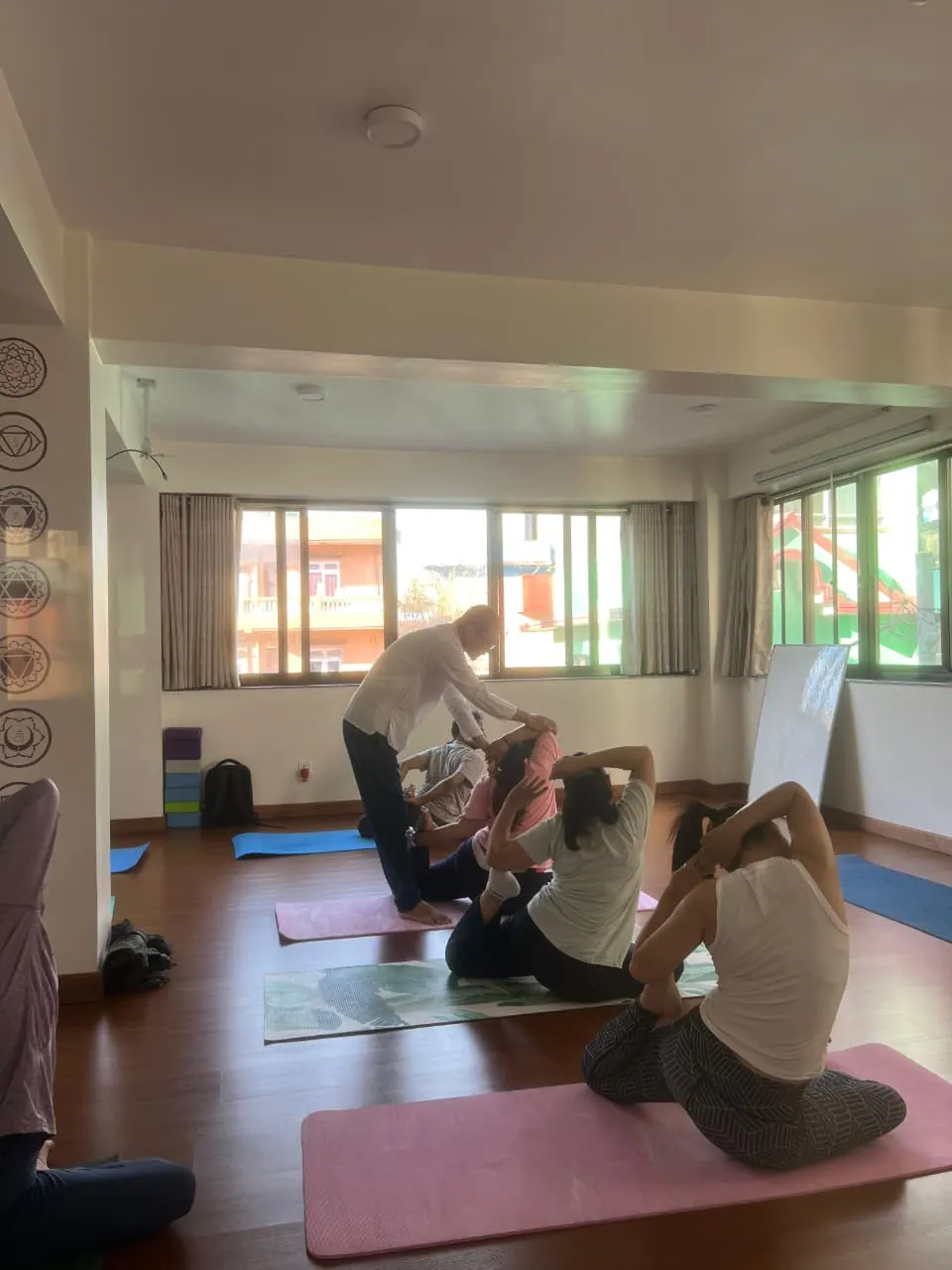
Mornings start early, often before breakfast, with the longer practice of the day. Many traditions treat early morning as the best time for practice, and there is a practical reason too: the day has not yet made demands on you.
Breakfast follows. Then a gap — and this is the part people underestimate. A retreat schedule usually has several hours of nothing in particular. Reading, walking, sleeping, sitting. For people used to constant input, the first two days of that can feel genuinely uncomfortable.
Afternoons might hold a workshop, a discussion, a slower practice or an outing. Evenings tend towards quieter work: restorative postures, breathing, meditation, sometimes a sound session.
Food is generally simple and vegetarian. Alcohol is usually absent. Phones are often discouraged rather than confiscated.
Being honest about the first two days
Most people have a harder first 48 hours than the photographs suggest.
Common experiences: difficulty sleeping in an unfamiliar bed, mild headaches from caffeine reduction, restlessness during unstructured time, irritation at the schedule, and a strong urge to check messages. Some people feel unexpectedly emotional.
None of this means the retreat is wrong for you. It is closer to withdrawal from a normal pace than a sign of failure. It usually settles.
Knowing it is coming makes it considerably easier.
Trekking: what to be realistic about
If you are considering the trekking option, a few things deserve straight answers.
Fitness. You should be able to walk for four to six hours on uneven ground, on consecutive days. You do not need to be an athlete, but arriving unprepared makes the first days miserable.
Altitude. This is the one that matters most. Altitude sickness can affect anyone above roughly 2,500 metres regardless of fitness or previous experience, and being fit offers no protection. Symptoms include headache, nausea, dizziness, fatigue and difficulty sleeping. The NHS guidance on altitude sickness is worth reading before you book, as is the CDC's guidance on high-elevation travel.
The important principle is to ascend gradually and to descend if symptoms worsen. Never continue climbing with worsening symptoms, and tell your guide early rather than pushing on quietly. Discuss any heart, lung or blood condition with your doctor before committing to a trek at elevation.
Weather. Conditions on Himalayan trails change quickly, and mountain visibility is seasonal. Our guide to the best time for yoga training in Kathmandu covers the seasons in detail; the same logic applies to trekking, with autumn generally the most reliable.
Insurance. Check that your travel insurance covers trekking at the elevations you will reach. Many standard policies do not.
Structured programmes
Not every longer programme is a retreat in the restful sense.
The weight-loss bootcamp is a guided, progressive programme in Kathmandu rather than a rest-focused retreat. It is structured work over time, and worth approaching as such.
If your interest is specifically in weight and health, be cautious with the claims you will encounter elsewhere — our post on weight loss myths versus facts covers some of the more common ones.
Choosing between them
A few honest questions usually settle it.
1. Do you want rest, or do you want challenge? Both are legitimate. Confusing them is the main source of disappointment. 2. How much unstructured time can you tolerate? If the answer is "very little", a trek or a structured programme may suit you better than a still retreat. 3. How fit are you, honestly? Not how fit you intend to be by then. 4. Are you travelling to Nepal anyway? Combining a retreat with existing travel changes the calculation considerably. 5. What season can you come in? This affects trekking far more than it affects a valley-based retreat. 6. Any health conditions? Altitude, heat and unfamiliar food all interact with existing conditions. Ask your doctor before booking, not after.
What to bring
Beyond the usual travel items, a few things specific to this.
- Layers. Mountain temperatures swing widely between day and night.
- Broken-in walking boots for any trek. New boots are a reliable way to ruin a week.
- A refillable water bottle, and a way to treat water if you are trekking.
- Modest clothing for temples and village settings.
- Any personal medication, plus copies of prescriptions.
- A book. The unstructured gaps are longer than you expect.
- Low expectations about connectivity on trails.
How we approach this at Yogmandu
At Yogmandu we would rather place you in the right programme than the most expensive one. If you are exhausted, we will say a trek is the wrong choice. If you are fit and restless, a still retreat may frustrate you.
Our trekking runs in small groups, which matters at elevation — a guide who knows how everyone is doing can act early when someone is struggling, and a small group can change its plans without a negotiation.
We ask about health conditions, previous experience and fitness before confirming a place, and we would rather have an awkward conversation in advance than an emergency on a trail. If altitude is a concern for you, say so early and we can talk about lower-elevation alternatives.
Yogmandu is a yoga school in Mid-Baneshwor, Kathmandu, founded in 2018 and Nepal's first Yoga Alliance registered school. If you are weighing up options, contact us with your dates, fitness level and what you are hoping to get from it.
Frequently asked questions
### Do I need to be experienced to join a retreat?
Usually not. Most retreats accommodate beginners, and instruction is adjusted. Say clearly what your experience is when booking so the programme can be pitched appropriately.
### How fit do I need to be for a yoga trek?
Fit enough to walk four to six hours on uneven ground for consecutive days. Fitness does not protect against altitude sickness, so being fit is necessary but not sufficient.
### What if I get altitude sickness?
Tell your guide immediately. The standard response is to stop ascending and, if symptoms worsen, to descend. Do not continue upward hoping it passes, and do not keep it to yourself.
### Can I do a retreat if I have a health condition?
Often, but speak with your doctor first and tell the organisers before booking. Altitude, heat, dietary changes and unfamiliar routines all interact with existing conditions.
### Is a retreat just a holiday?
Not really. Retreats involve early starts, a set schedule, simple food and often no alcohol. Many people find them restorative, but restorative is not the same as relaxing in the holiday sense.
---
Sources
- Altitude sickness — NHS
- High Elevation Travel & Altitude Illness — US Centers for Disease Control and Prevention