Corporate Yoga: What a Programme Involves

Thinking about yoga for your team in Kathmandu? A practical guide to space, formats, timing, costs in disruption and keeping attendance up.
Most workplace wellness ideas fail for the same reason: they sound good in a meeting and then quietly stop happening by week four.
If you are the person who would have to arrange yoga for your team, you are probably less interested in whether yoga is beneficial and more interested in practical questions. Where would it happen? How long does it take? What does it cost in disruption? And will anyone actually turn up after the first session?
This is a practical guide to how corporate yoga works in an ordinary office, written for the person who has to organise it.
What a session actually looks like
You do not need a studio, a dedicated wellness room or a renovation.
Most on-site sessions happen in whatever space a company already has: a meeting room with the table pushed aside, a training room, a reception area after hours, a canteen, or a quiet corner of an open-plan floor. What matters is enough floor space for people to stand with their arms out without hitting each other, and a door that can be closed or a corner that feels reasonably private.
Two formats cover almost every office.
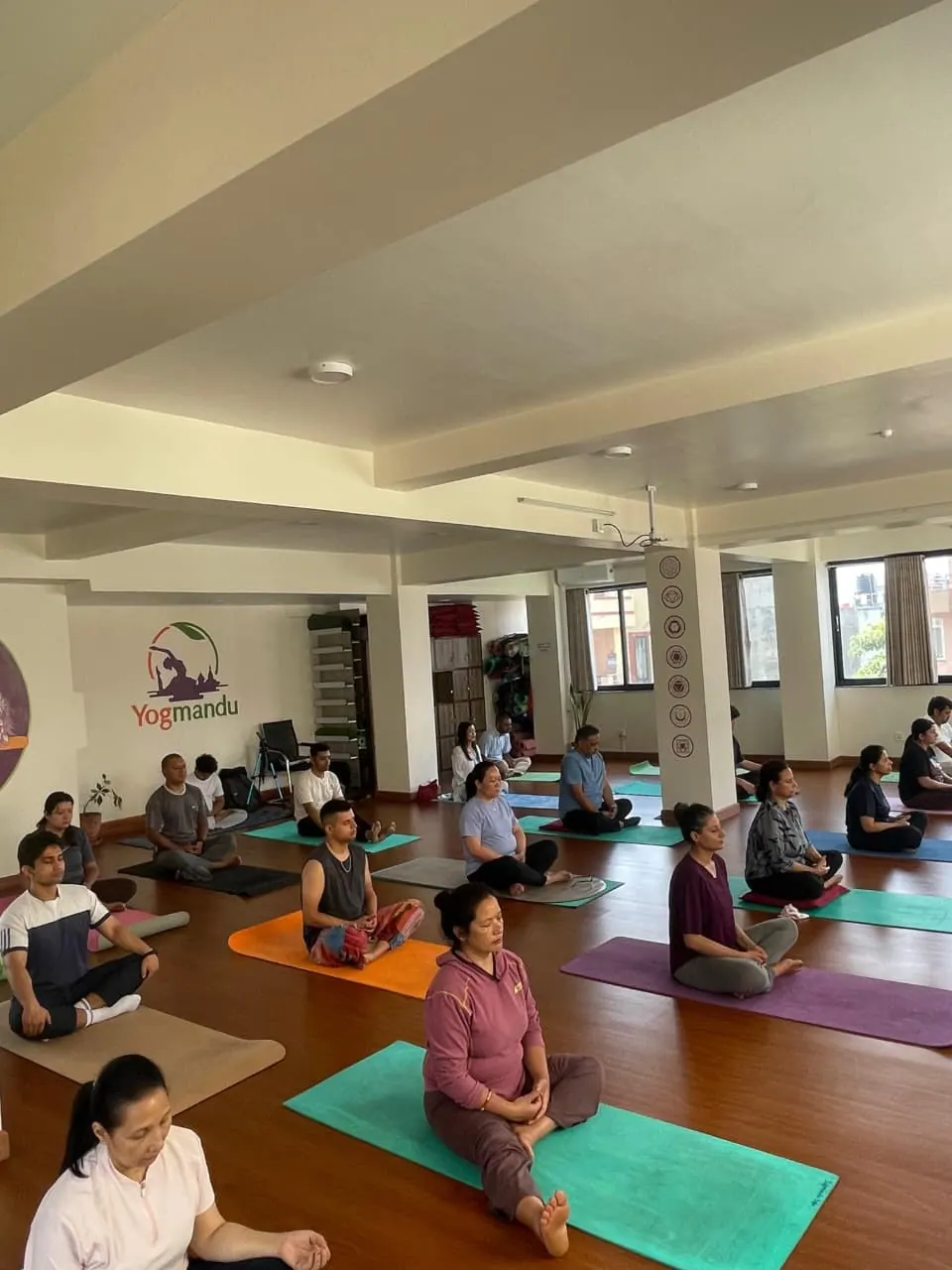
Mat-based sessions use yoga mats on the floor. Staff usually change into comfortable clothes, or wear something loose to work that day. This suits companies with a spare room and a team willing to change.
Chair-based sessions happen at or beside desks, in ordinary work clothes, with no mats at all. People stay seated for much of it, with some standing movement beside the chair. It looks far less like a yoga class and far more like a guided stretch and breathing break.
Chair-based is the answer to most objections. It removes the space problem, the changing problem, and the self-consciousness problem in one go.
Format and timing
There is no single correct schedule, but a few patterns work more reliably than others.
- Weekly, same day and time. The most effective option, because it becomes part of the week rather than something people have to decide about.
- Fortnightly. A reasonable compromise when budget or diaries are tight.
- One-off workshop. Good for a team day, a stressful period, or testing appetite before committing.
- Lunchtime. Popular, but keep it short enough that people can still eat.
- End of day. Often the easiest to protect from meetings overrunning.
Most sessions run 45 to 60 minutes. That fits a standard meeting slot, which matters more than it sounds: a session that fits an existing calendar block is far easier to defend than one that needs a special arrangement.
Shorter chair-based sessions of 20 to 30 minutes also work well, particularly for teams that will not commit to an hour.
What staff actually get from it
Here is where most corporate wellness material overreaches, so let us be careful.
You will find plenty of claims online about productivity percentages, absenteeism reductions and return on investment. We are not going to quote figures at you, because the honest position is that workplace wellness research is mixed, the studies vary enormously in quality, and any number specific enough to be persuasive is usually specific enough to be unreliable.
What we can describe is what people commonly report and what you can observe yourself:
- Relief from the physical effects of sitting — tight hips, stiff upper backs, sore necks and shoulders.
- A genuine mental break in the middle of a working day, which is different from scrolling a phone at a desk.
- A shared non-work activity, which teams that never socialise outside work often value more than the yoga itself.
- A signal from the employer that staff wellbeing is worth spending money and time on.
That last one does real work. Staff notice what a company pays for.
If back and neck discomfort is the main driver, it is worth reading our guide to desk yoga for back, neck and shoulder pain, which covers what sitting all day does and what helps.
Common objections, answered honestly
### "Our staff aren't flexible"
Neither are most people who start yoga. Flexibility is not an entry requirement, and a corporate session is not a class of advanced poses. A well-run workplace session is built around what people can do in a meeting room, not around impressive shapes.
### "We don't have the space"
Then run a chair-based session. People practise at their desks or beside them. No mats, no changing, no room booking.
### "The men won't join in"
This comes up often, and it is usually a framing problem. Sessions described as stretching, mobility and breathing for people who sit all day tend to get broader attendance than sessions described as yoga. The content can be identical.
### "We tried it and attendance dropped off"
Very common, and usually fixable. Attendance falls when the time moves around, when meetings are allowed to overrun into the slot, when nobody internally owns it, or when the first session was pitched at the wrong level. A fixed time, a protected calendar slot and an internal champion matter more than the teacher's skill.
### "We're too busy right now"
A fair point, and sometimes true. But the periods when a team is too busy to stop are usually the periods when a 45-minute break has the most effect. If the timing is genuinely wrong, a one-off workshop later is better than forcing a weekly commitment now.
What to think about before booking
A few practical decisions make the difference between a programme that lasts and one that fades.
1. Who champions it internally? Someone needs to send the invitation, protect the slot and remind people. Without that, attendance decays regardless of how good the sessions are. 2. How many people? Group size affects how much individual attention is possible. Very large groups need a different approach from a team of eight. 3. What is the commitment? A block of six or eight weekly sessions gives people time to form a habit. A single session is a taster, not a programme. 4. Mixed ability is the norm. Expect complete beginners alongside people who already practise. Sessions should be built for that rather than treating it as a problem. 5. Seasonal reality. Kathmandu mornings are cold in winter and warm rooms get stuffy in late spring. It affects what format works when. 6. On-site or virtual? Distributed teams can join a live online session instead, which removes the space question entirely.
How a programme usually gets set up
The process is simpler than most people expect.
It starts with a short conversation about your team: how many people, what space you have, what times could work, and whether anyone has injuries or health conditions the teacher should know about.
From there you would usually agree a format — mat or chair, on-site or virtual — and a trial block. A first session then runs, and it is genuinely worth gathering honest feedback afterwards. Staff will tell you quickly whether the time slot is wrong or the pace was off, and both are easy to adjust early.
After that it is mostly logistics: a recurring calendar invite, a protected room, and someone keeping an eye on attendance.
How we approach this at Yogmandu
At Yogmandu, corporate sessions are shaped around the workplace rather than transplanted from a studio class. We ask about your space, your team and your schedule before proposing a format, because a session that does not fit the working day will not survive contact with a busy week.
We run sessions on-site or virtually, and we are comfortable with chair-based formats for offices with no spare room. Staff do not need experience, equipment or particular clothing for a chair session.
We would also rather be honest about fit than sell you a programme that will not work. If your team is scattered across locations, a live online format may serve better than an on-site session. If people cannot reliably protect an hour, a shorter chair-based slot is more realistic than an ambitious one that gets cancelled.
Yogmandu is a yoga school in Mid-Baneshwor, Kathmandu, founded in 2018 and Nepal's first Yoga Alliance registered school. If you would like to talk through what might suit your workplace, contact us with a rough idea of team size, space and timing.
Frequently asked questions
### Do staff need to bring anything?
For a chair-based session, no. For a mat-based session, comfortable clothing is helpful, and mats can usually be arranged. Nobody needs to buy equipment to take part.
### How much space do we actually need?
Enough for each person to stand with their arms extended without touching anyone. A meeting room with the table moved aside is usually sufficient for a small team. Chair-based sessions need no extra space at all.
### What if some staff have injuries or health conditions?
Tell the teacher in advance where possible. Individuals should also mention anything relevant at the start of a session so alternatives can be offered. Anyone with a significant medical condition, recent surgery or persistent pain should check with their own clinician first.
### Can remote or hybrid teams join?
Yes. Live online sessions work well for distributed teams, and hybrid arrangements where some people are in the room and others join remotely are workable with a little planning.
### How long should we commit to at the start?
A block of six to eight weekly sessions is a reasonable first commitment. It is long enough for people to settle in and for you to judge whether it is working, without being a large open-ended spend.