
The Glory of Pashupati Kshetra: Nepal’s Sacred Realm of Liberation
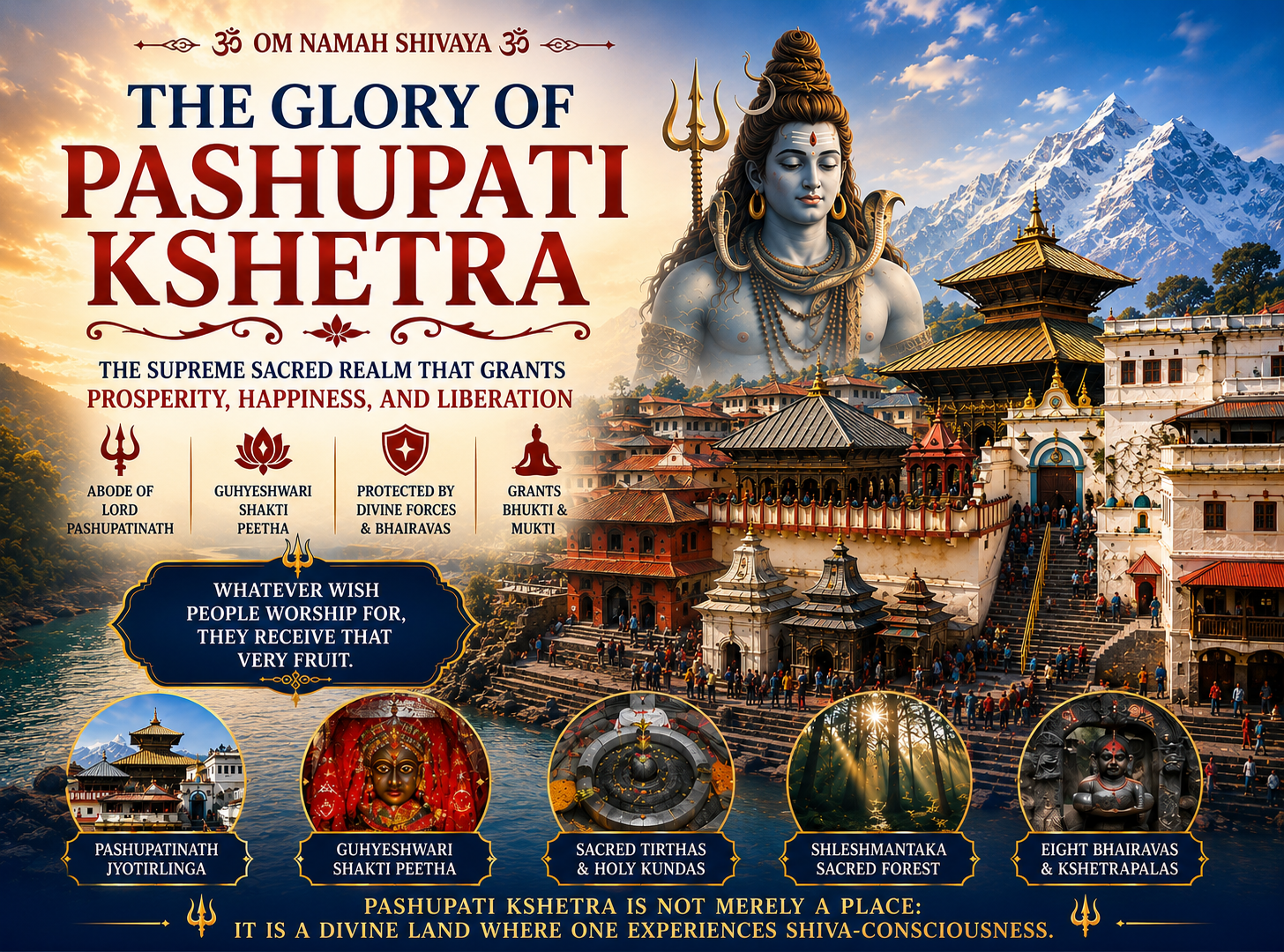
🕉 Om Namah Shivaya
The Glory of Pashupati Kshetra: Nepal’s Sacred Realm of Liberation
“Blessed is Pashupati Puri, the radiant city of Lord Shiva, where devotion, wisdom, and liberation unite.”
Introduction:
Nestled in the heart of Kathmandu Valley, the sacred Pashupati Kshetra is far more than the renowned Pashupatinath Temple. According to the ancient Skanda Purana (Himavat Khanda), this divine realm is one of the holiest Shaiva pilgrimage sites in the world—a spiritual city where gods, sages, yogis, and devotees have gathered for millennia in search of blessings, enlightenment, and liberation. The scriptures describe Pashupati Kshetra as a land desired even by the gods, a place capable of granting both Bhukti (worldly prosperity) and Mukti (spiritual liberation). It is regarded as the living abode of Lord Shiva, where every stone, forest, river, and shrine is infused with sacred energy.
A Divine Geography:
The sacred geography of Pashupati Kshetra extends far beyond the central temple. The Purana describes a vast divine territory bounded by holy mountains, rivers, and shrines.
Within this region lie sacred places such as: -Pashupatinath Jyotirlinga -Guhyeshwari Shakti Peetha -Mrigasthali Forest -Koteshwar -Vikateshwar -Chandan Bhairava -Godavari Tirtha -Hari Tirtha -Vajrayogini -Harihara Kshetra
The scriptures proclaim that the entire area is a Moksha Kshetra—a field of liberation where spiritual practice bears extraordinary fruit.
The Abode of Lord Pashupatinath:
At the center of this sacred realm shines Lord Pashupatinath, revered as the Lord of all living beings.
The Purana describes Him as a Jyotirlinga, an eternal pillar of divine light surrounded by: -Gupta Devi -Yoginis -Pramatha Ganas -Bhairavas -Divine Mothers (Matrikas)
As the spiritual heart of Nepal, Pashupatinath symbolizes compassion, protection, and liberation for all beings.
The Sacred Union of Shiva and Shakti:
One of the most profound aspects of Pashupati Kshetra is the presence of Guhyeshwari Devi, one of the most revered Shakti Peethas in South Asia. The sacred connection between Pashupatinath (Shiva) and Guhyeshwari (Shakti) represents the eternal union of consciousness and energy.
The scriptures describe how divine manifestations of the Mother Goddess dwell throughout the region, including: -Brahmi -Maheshwari -Kaumari -Varahi -Narasimhi -Shivaduti
Together they protect the sacred realm and bless sincere devotees.
A Land Sanctified by Gods and Sages:
Pashupati Kshetra has long been a destination for spiritual seekers.
The Purana recounts that many great beings performed austerities here, including: -Lord Vishnu -Sage Kashyapa -Markandeya -Ashwatthama -King Bali -Sage Vyasa -Hanuman -Kripacharya -Lord Rama -Vibhishana
It is said that even Vishnu attained Lakshmi's grace after performing penance in this sacred field.
The Sacred Forest of Shleshmantaka:
Adjacent to Pashupatinath lies the legendary Shleshmantaka Forest, celebrated in the scriptures as a divine woodland blessed by Shiva's grace.
Traditionally regarded as a place of meditation and spiritual retreat, the forest symbolizes:
-Inner purification -Yogic contemplation -Connection with nature -Spiritual awakening
For centuries yogis and ascetics have sought solitude within its sacred atmosphere.
Guardians of the Sacred Realm:
The Purana describes Pashupati Kshetra as being continuously protected by divine guardians.
These includes:
The Eight Bhairavas: -Unmatta Bhairava -Asitanga Bhairava -Ruru Bhairava -Kala Bhairava -Samhara Bhairava -Krodha Bhairava -Ananda Bhairava -Chanda Bhairava
Directional Deities: -Indra -Agni -Varuna -Vayu -Kubera -Ishana -Nirriti
Other Protectors: -Siddha Ganesha -Kshetrapala -Vasuki Naga -Virupaksha Bhairava -Ananta
These divine beings ensure the sanctity and spiritual power of the sacred region.
A City Built on the Thousand-Petaled Lotus
One of the most beautiful descriptions found in the Purana compares Pashupati Puri to a thousand-petaled lotus.
The city itself rests upon the lotus petals, while Lord Shiva resides in the central core, just as supreme consciousness resides within the human heart.
This symbolism reflects profound yogic teachings:
-The lotus represents spiritual awakening. -The thousand petals symbolize enlightenment. -The central point represents union with the Divine.
Thus, Pashupati Kshetra is not merely a physical location—it is a sacred map of spiritual realization.
The Promise of Bhukti and Mukti
The central message of the Purana is clear: Pashupati Kshetra grants both worldly and spiritual fulfillment.
Devotees visit seeking: -Health -Prosperity -Protection -Wisdom -Spiritual growth -Liberation
The scriptures affirm that sincere worship, meditation, and pilgrimage performed in this sacred realm yield extraordinary merit.
Why Pashupati Kshetra Matters Today:
In an age of distraction and constant activity, Pashupati Kshetra remains a timeless sanctuary.
Pilgrims who walk its ancient paths encounter: -Sacred temples -Living spiritual traditions -Himalayan devotion -Yogic wisdom -Profound inner silence
Whether one approaches as a devotee, a seeker, a scholar, or a traveler, Pashupati Kshetra offers a unique opportunity to connect with Nepal's deepest spiritual heritage.
Conclusion
The Skanda Purana presents Pashupati Kshetra as more than a temple complex—it is a divine city, a sacred mandala, and a gateway to liberation. Protected by gods, blessed by sages, and illuminated by the presence of Lord Pashupatinath, this holy realm continues to inspire millions of pilgrims from around the world. As the scriptures proclaim, every part of this sacred land is filled with Shiva's presence, making Pashupati Kshetra one of the greatest spiritual treasures of Nepal and the entire Hindu world.
Om Namah Shivaya.
**Source: Skanda Purana, Himavat Khanda – Pashupati Kshetra Mahatmya